
Every applicant who wants to practice nursing in Washington must go through WA nursing license fingerprinting before the Board of Nursing will approve an application. This requirement applies to Registered Nurses, Licensed Practical Nurses, Advanced Registered Nurse Practitioners, and Nursing Technicians. If you are starting the process for the first time, understanding how WA nursing license fingerprinting works will save you time, money, and frustration.
The Washington State Board of Nursing, often called WABON, processes every license application that comes through its office. Part of that process is a criminal background check, and the most reliable version of that check depends on fingerprints. That is why WA nursing license fingerprinting sits at the center of the entire licensing timeline. Without a clean, correctly submitted fingerprint record, your application simply cannot move forward.
This guide walks through everything you need to know about WA nursing license fingerprinting in plain language. We cover who needs it, why it matters, how the background check system works, what to expect during your appointment, common mistakes that slow applicants down, and how to keep the whole process moving quickly. Whether you are a new graduate, a nurse moving from another state, or someone reactivating an old license, this article will help you understand exactly what is expected of you.
Why WA Nursing License Fingerprinting Matters
Washington law requires a criminal background check on every nursing license application. WABON believes that nurses come from diverse backgrounds and life experiences, and the board supports people pursuing a nursing career even after a past conviction, when it is safe to do so. Still, the board must verify identity and criminal history accurately, and that is exactly what WA nursing license fingerprinting accomplishes.
Unlike a simple name search, a fingerprint based background check confirms your identity through a physical, unique marker that cannot be faked or confused with someone else’s record. This matters enormously in a profession built on trust. Patients, employers, and regulators all rely on the assurance that the person holding a nursing license is exactly who they say they are, and WA nursing license fingerprinting provides that assurance.
The Three Types of Background Checks You Might Encounter
As you move through nursing school, clinical placements, and licensure, you may encounter more than one kind of background check. Understanding the differences helps you see exactly where WA nursing license fingerprinting fits into the bigger picture.
The first is the Washington State Patrol fingerprint based background check. This is the official criminal history record tied to your fingerprints. It captures Washington arrests, charges, dispositions, and convictions, and if the FBI portion is requested, it also captures nationwide criminal history. Because identity is confirmed through fingerprints, this check is the most reliable form of identity verification available, though it takes longer to complete since it depends on the vendor and, when applicable, the FBI. This is the version required for nursing licensure and for many long term care positions.
The second is WATCH, which stands for Washington Access to Criminal History. This tool searches by name and date of birth rather than fingerprints. It returns Washington conviction records for felonies and gross misdemeanors, along with recent arrests still pending disposition, and registered sex or kidnapping offenders. Because it is not fingerprint verified, WATCH carries a higher risk of false matches, and it only searches Washington records. It is publicly accessible, which makes it useful for quick checks but not a substitute for WA nursing license fingerprinting.
The third is the DSHS background check, sometimes called BCCU. This is a consolidated report pulling from multiple sources, including state patrol criminal history, FBI criminal history when fingerprint based, DSHS findings related to protective services, Department of Corrections data, self disclosure, and multistate searches where available. This check also includes noncriminal DSHS findings such as documented abuse, neglect, or exploitation, and results are used for eligibility and suitability decisions in settings serving vulnerable populations.
Knowing these distinctions matters because clinical sites and nursing programs sometimes require WATCH or DSHS checks in addition to the official licensing process. WA nursing license fingerprinting through the Washington State Patrol remains the version that WABON itself relies on for licensure decisions.
Who Needs to Complete WA Nursing License Fingerprinting
Every applicant type falls under this requirement. That includes Registered Nurses applying by examination or endorsement, Licensed Practical Nurses, Advanced Registered Nurse Practitioners, and Nursing Technicians. It also applies to nurses educated outside the United States who are seeking Washington licensure, and to military affiliated applicants using one of the state’s military licensure pathways.
If you already hold an active Washington license and are simply renewing, you generally will not need to repeat WA nursing license fingerprinting, since your background was already verified when you were first licensed. However, if your license has lapsed, if you are reactivating after a long period of inactivity, or if you are upgrading to a multistate license, the board may ask you to complete a new fingerprint based check to confirm your record is still current.
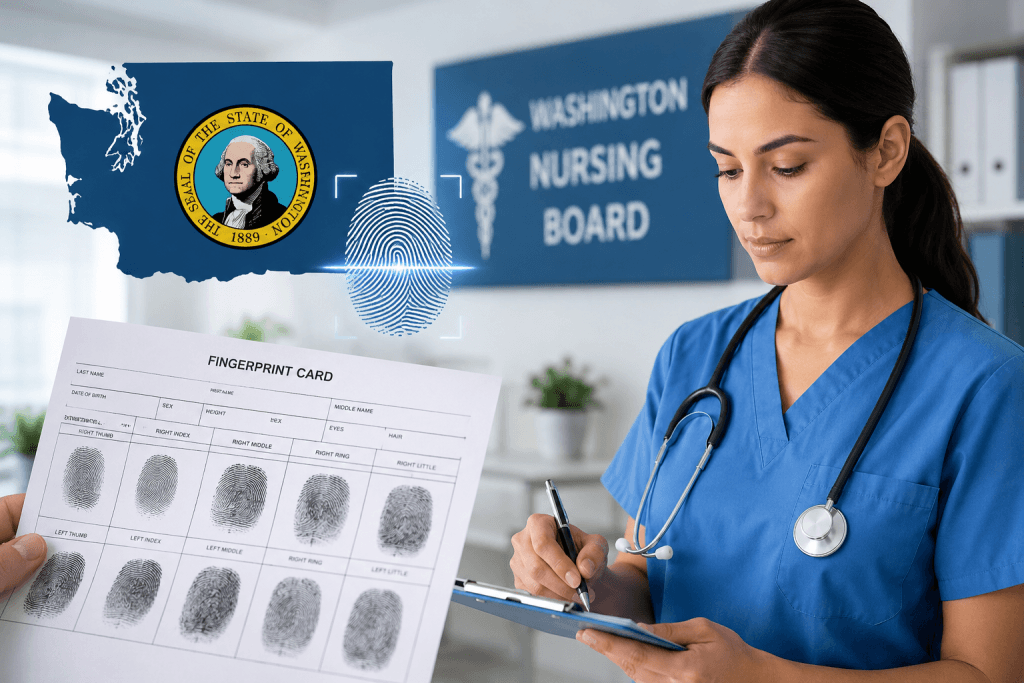
How the WA Nursing License Fingerprinting Process Works
While the exact steps can shift slightly depending on how you apply, the general flow of WA nursing license fingerprinting follows a consistent pattern. Here is what most applicants can expect.
First, you submit your license application through the board’s online licensing portal. This is the same portal used for renewals, changes to personal information, and workforce data submissions. Once your application is in the system, the fingerprint requirement becomes part of your file.
Second, you arrange your fingerprint appointment. Depending on your situation, this may happen through a designated fingerprinting vendor, a law enforcement agency, or another approved location. During the appointment, a technician captures your fingerprints electronically or on a card, along with basic identifying information such as your name, date of birth, and a form of government issued identification. Bring valid photo identification to every appointment, since technicians cannot proceed without it.
Third, your fingerprints are transmitted to the Washington State Patrol, and if requested, onward to the FBI. This is where WA nursing license fingerprinting takes the most time, since turnaround depends on the vendor’s processing speed and on federal review when a nationwide check is included. Applicants should expect this step to take anywhere from a few days to several weeks, so planning ahead is wise.
Fourth, once results are returned, they become part of your official application file. If everything is clear, this step typically causes no delay to your licensure timeline. If a positive result appears, meaning something did show up on your record, the board reviews it individually rather than issuing an automatic denial.
Preparing for Your Fingerprint Appointment
A little preparation goes a long way toward making WA nursing license fingerprinting quick and painless. Start by confirming exactly which type of check your application requires, since some applicants need only the state level check while others need the FBI portion as well. The board will notify you directly if an FBI check is necessary, so watch your email and your online portal messages closely.
Next, gather your identification documents ahead of time. A valid, unexpired, government issued photo identification is required at every fingerprinting appointment. Common examples include a driver license, a state identification card, or a passport. If your name on your identification does not match the name on your nursing application, resolve that discrepancy before your appointment, since mismatched names are one of the most common reasons WA nursing license fingerprinting appointments get delayed or rejected.
It also helps to keep your hands clean and free of lotion, cuts, or bandages before your appointment. Fingerprint scanners read the ridges on your skin, and anything that obscures those ridges, including dry skin, moisture, or minor injuries, can produce a poor quality print that must be retaken.
Finally, keep a copy of your receipt or confirmation number from your fingerprinting appointment. While WABON typically receives results directly from the state patrol, having your own record gives you something to reference if you ever need to follow up on a delay.
What Happens If You Have a Criminal History
Many applicants worry that any past conviction will automatically block their nursing career. That is not how Washington’s system works. WABON has stated clearly that it supports individuals pursuing nursing careers following past convictions, when it is safe to do so, and the board reviews these situations individually rather than applying a blanket rule.
If your WA nursing license fingerprinting results return a positive match, meaning something appears on your criminal history, the board follows its own procedure and criteria for reviewing license applications. This includes looking at factors such as the nature of the offense, how much time has passed, and evidence of rehabilitation. There is also a published list of disqualifying convictions that specifically affects clinical placements in certain care settings, which is separate from the licensing decision itself.
If the board needs additional information, such as court records, treatment documentation, or a personal statement, it will contact you directly. Applicants are encouraged to speak with their nursing program about any conviction history early, since some clinical placement sites have their own restrictions separate from WABON’s licensing requirements. Being upfront rather than waiting for a problem to surface tends to produce a smoother experience.
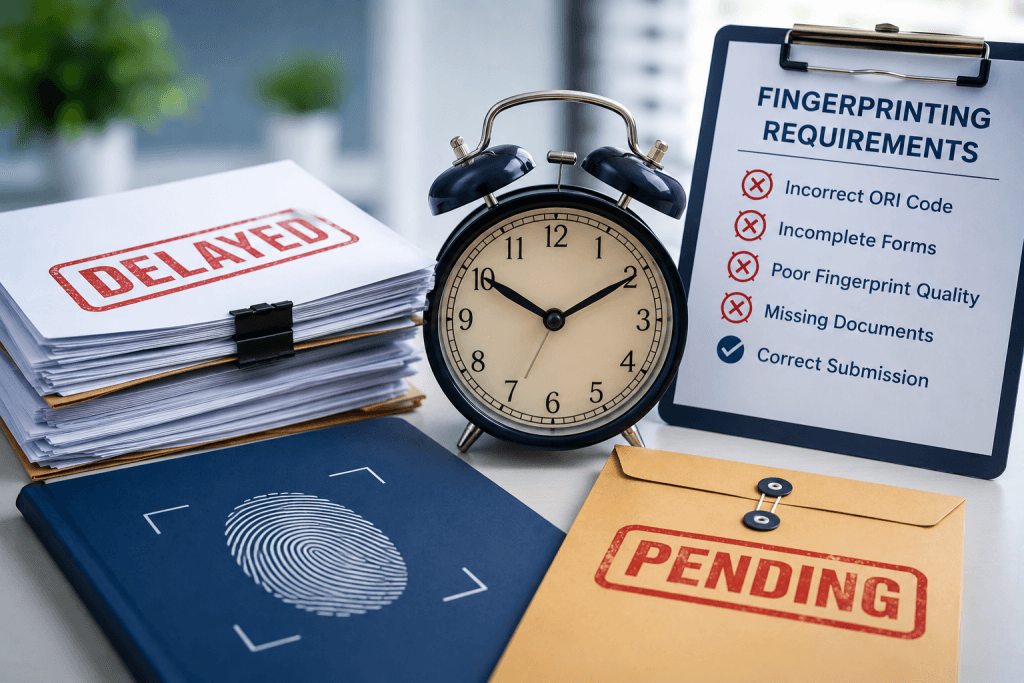
Common Mistakes That Slow Down WA Nursing License Fingerprinting
Even a straightforward process like WA nursing license fingerprinting can get delayed by small, avoidable errors. Here are the mistakes applicants make most often.
Missing or mismatched identification causes more delays than any other single factor. If your legal name has changed due to marriage, divorce, or another reason, and your identification has not been updated to match your application, resolve that before your appointment.
Waiting too long to schedule the appointment is another common problem. Because WA nursing license fingerprinting can take days or weeks to process, especially when an FBI check is involved, applicants who wait until the last minute often find themselves unable to start a new job or clinical rotation on schedule.
Submitting fingerprints under the wrong purpose code or through the wrong vendor pathway can also cause results to be misrouted and never reach your file. Always confirm with the board’s licensing portal exactly which pathway applies to your application type before you schedule anything.
Finally, some applicants assume that a background check completed for a different purpose, such as employment or a different state’s licensing board, will automatically transfer to Washington. It will not. WA nursing license fingerprinting must be completed specifically for your Washington nursing application, through the channel the board recognizes, or it will not count toward your file.
How Long Does WA Nursing License Fingerprinting Take
Timelines vary depending on whether your check includes only the Washington State Patrol portion or the full FBI portion as well. A state only check often returns results within a matter of days. A check that includes the FBI portion typically takes longer, sometimes several weeks, because it depends on federal processing volume in addition to the state vendor’s turnaround.
Because of this variability, the board strongly encourages applicants to begin the fingerprinting step as early as possible, rather than waiting until every other part of the application is finished. Starting WA nursing license fingerprinting early gives you a buffer in case anything needs to be resubmitted, such as a smudged print or a mismatched identification document.
Frequently Asked Questions About WA Nursing License Fingerprinting
Do I need to redo my fingerprints if I already completed a background check for nursing school?
In many cases, yes. Nursing programs often use WATCH or a DSHS check for placement purposes, and neither automatically satisfies the licensing board’s fingerprint based requirement. WA nursing license fingerprinting for your actual license application is typically a separate step.
What if I live out of state?
Out of state and international applicants can generally still complete WA nursing license fingerprinting through an approved vendor, and the board’s online portal provides guidance for applicants not physically located in Washington when they apply.
Will a past arrest that never led to a conviction show up?
It might appear on certain reports, particularly recent arrests with pending charges, but an arrest alone is treated very differently from a conviction during review.
How do I know if my results were received?
Check your application status through the board’s online licensing portal, since results from WA nursing license fingerprinting are typically routed directly into your file once processing is complete.
Final Thoughts on WA Nursing License Fingerprinting
Getting fingerprinted is one of the simplest yet most essential steps in becoming a licensed nurse in Washington. WA nursing license fingerprinting exists to protect patients, support employers, and give every nurse the credibility that comes with a verified, trustworthy record. While it can feel like just another form to fill out, treating it seriously, scheduling it early, and preparing properly will keep your path to licensure moving smoothly.
If you take away one thing from this guide, let it be this. WA nursing license fingerprinting is not something to fear or delay. It is a routine, well established part of joining a respected profession, and thousands of nurses complete it successfully every year. Bring valid identification, keep your hands clean and free of injury, confirm the correct vendor pathway, and submit your prints as early in the application process as you reasonably can.
Choosing Where to Get Fingerprinted
Applicants often ask where they can actually go to complete WA nursing license fingerprinting. Options generally fall into a few categories. Many applicants use an electronic scanning service, sometimes called Live Scan, where a technician captures your prints digitally and transmits them directly to the Washington State Patrol. Others complete the process using an ink card, which is then mailed to the appropriate agency. Some law enforcement agencies also offer fingerprinting services to the public for a fee.
Confirm ahead of time that the location can produce results in the format the board accepts. Not every fingerprinting service transmits directly to the correct agency, and a printed card sent to the wrong address can sit unprocessed for weeks. Checking with your chosen provider about their experience handling WA nursing license fingerprinting for healthcare licensing saves considerable time.
Cost is another factor applicants weigh. Fees vary by vendor and by whether you need the state only check or the combined state and FBI check. Ask for a full breakdown before your appointment so there are no surprises, and keep your receipt in case you need to demonstrate that WA nursing license fingerprinting was completed on a specific date.
What Happens After You Submit Your Prints
Once your fingerprints are transmitted, there is little for you to do except monitor your application status. The board’s online portal is the best place to check whether your file shows completed WA nursing license fingerprinting results. Many applicants check daily out of anxiety, but results typically post automatically once the state patrol, and the FBI if applicable, complete their review, so frequent checking will not speed up the process itself.
If a significant amount of time passes with no update, reach out to the board directly. Have your application number and the date of your fingerprinting appointment ready, since this helps staff locate your file quickly. In many cases, a delay simply reflects normal federal processing volume rather than a problem with your submission.
Once your background check clears, the board moves on to reviewing the remaining pieces of your application, such as education verification and examination results, or verification of an existing license for those applying by endorsement. WA nursing license fingerprinting is just one piece of a larger puzzle, but it is often the piece that takes the longest, so treating it as a priority from day one makes the rest of the process feel much faster.
Fingerprinting for Multistate and Military Pathways
Nurses pursuing a multistate license, which allows practice across states that participate in the Nurse Licensure Compact, should pay close attention to WA nursing license fingerprinting requirements as well. Since a multistate license extends your ability to practice beyond Washington’s borders, the identity verification standard tends to be strict, and a clean fingerprint based background check is essential to approval.
Military affiliated applicants, including active duty service members, veterans, and military spouses using one of the state’s dedicated licensure pathways, still need to complete WA nursing license fingerprinting. The state offers some flexibility for those stationed outside Washington, but the underlying requirement does not change, so reach out to the board early to confirm vendor options near your duty station.
Working with an experienced, professional fingerprinting provider can make the entire experience faster and less stressful. A knowledgeable technician who understands the specific requirements of WA nursing license fingerprinting can help you avoid the common errors that lead to delays, ensuring your prints are captured correctly the first time. That small step of choosing the right provider often makes the biggest difference in how smoothly your nursing license application moves from submission to approval.
A Quick Checklist Before Your Appointment
Before you walk into any location to complete WA nursing license fingerprinting, run through a short checklist. Confirm your application is already submitted through the board’s portal, since fingerprinting typically ties back to an existing file. Bring valid, unexpired, government issued photo identification that matches the name on your application. Arrive with clean, uninjured hands. Know whether you need the state only check or the combined state and FBI check. Keep a confirmation number or receipt afterward.
Following this simple checklist turns WA nursing license fingerprinting into a quick, routine errand. Thousands of Washington nurses complete this step every year without incident, and with a little preparation, you can expect the same smooth experience.