
If you have ever wondered how long do fingerprints last, you are not alone. This question comes up in criminal investigations, background checks, and even everyday curiosity.
The answer is not as simple as it sounds. Fingerprint longevity depends on the surface, the environment, the person, and the method used to detect them.
Understanding fingerprint duration is important for law enforcement, employers, notaries, and anyone navigating identity verification today.
What Makes a Fingerprint?
Every fingerprint is made of ridges and valleys unique to each person. When your finger touches a surface, it leaves behind sweat, oil, and other residues in the exact pattern of those ridges.
This deposit is what investigators, technicians, and analysts refer to when they talk about a latent fingerprint. It is invisible to the naked eye in most cases and requires special processing to reveal.
The composition of this residue includes water, amino acids, fatty acids, proteins, and trace minerals. Each of these components behaves differently over time, which directly affects how long do fingerprints last in any given scenario.
How Long Do Fingerprints Last on Different Surfaces?
The surface a fingerprint lands on is one of the biggest factors in how long it survives. Not all surfaces hold prints equally.
Smooth, Non-Porous Surfaces
On glass, mirrors, polished metal, and plastic, fingerprints can last for weeks or even months under ideal conditions. These surfaces do not absorb the residue, so the print sits on top where it is preserved until disturbed.
A fingerprint on a sealed glass jar stored in a cool, dry location has been detected years after it was deposited. This is one reason why how long do fingerprints last on glass is a topic of serious scientific study.
Porous Surfaces
Paper, cardboard, untreated wood, and fabric absorb fingerprint residue quickly. This absorption actually helps preserve the chemical trace, especially the amino acids, for extended periods.
Researchers have successfully developed fingerprints on paper documents that were decades old using advanced chemical techniques like ninhydrin or DFO treatment.
Rough and Textured Surfaces
Brick, concrete, leather, and heavily textured plastics hold prints poorly. The ridges do not make consistent contact, so the deposit is fragmented and fades faster.
On these types of surfaces, how long do fingerprints last is significantly reduced, often to a matter of days or less depending on environmental exposure.
Environmental Factors That Affect Fingerprint Lifespan
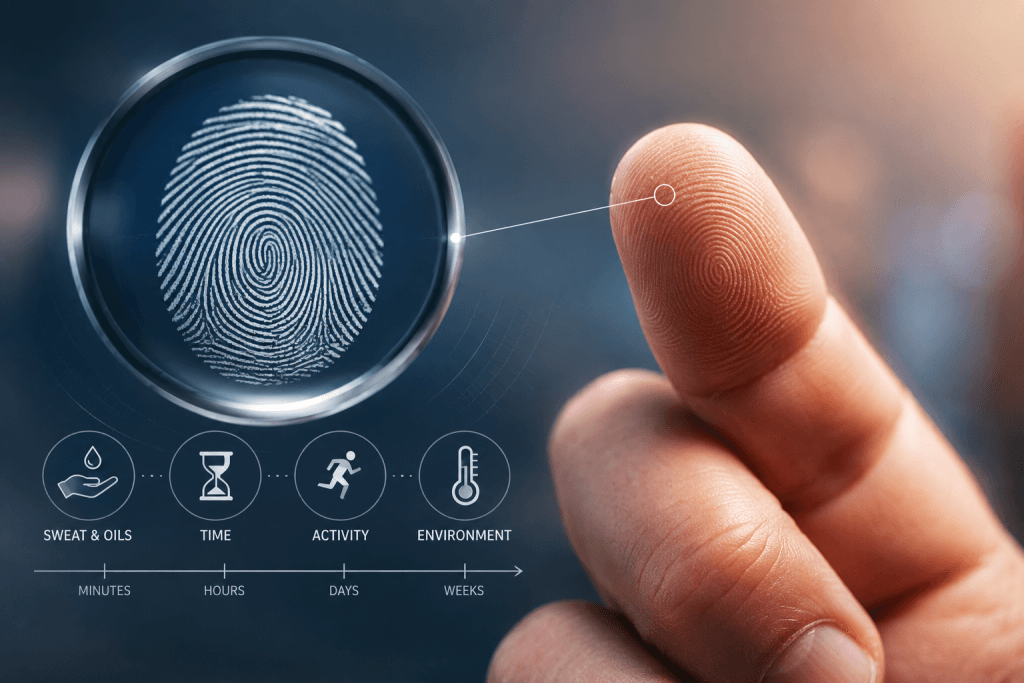
Once a fingerprint is deposited, the surrounding environment plays a massive role in how long it survives.
Heat and Sunlight
High temperatures accelerate the evaporation of water-based compounds in fingerprint residue. Direct sunlight introduces ultraviolet radiation that degrades organic material rapidly.
A print left on a car dashboard in summer heat may disappear within hours, while the same print in a shaded, climate-controlled room could last for months.
Humidity
Moisture is a double-edged factor. A small amount of humidity can preserve amino acid-based components, but excessive moisture or rain can wash a print away entirely.
This is why how long do fingerprints last outdoors varies so dramatically between a dry desert climate and a rainy Pacific Northwest environment.
Wind and Airflow
Constant airflow carries dust particles that can contaminate a print, while also promoting evaporation. Prints in open-air environments tend to degrade much faster than those in enclosed spaces.
Contamination and Physical Disturbance
Any contact with the surface after deposition, whether from cleaning products, other hands, or simply dust settling, can obscure or destroy a fingerprint entirely.
How Long Do Fingerprints Last on the Human Body?
Fingerprints left on skin are among the most challenging to recover. The skin itself is warm, alive, and constantly producing oils and sweat that overwrite deposited prints.
In controlled conditions, latent fingerprints on skin can last between one and two hours before they degrade beyond usable recovery.
Forensic specialists use techniques like electrostatic lifting or vacuum metal deposition to attempt recovery in this narrow window. It is a race against time.
This limitation is one of the reasons why understanding how long do fingerprints last on living surfaces is a priority in forensic science research today.
How Long Do Fingerprints Last in Official Records?
This is where fingerprint longevity takes on a very different meaning. When it comes to criminal records, background checks, and government databases, the question of how long do fingerprints last becomes a matter of policy and law.
FBI and Federal Databases
Fingerprints submitted to the FBI through the Next Generation Identification system are retained indefinitely unless a specific legal process removes them.
If you were fingerprinted during an arrest, your prints remain in the federal system regardless of whether charges were dropped or you were found not guilty. Removal requires a formal expungement process.
State-Level Databases
Each state manages its own fingerprint retention policies. Some states delete prints after a set period if no conviction resulted. Others retain them permanently.
Employment and Licensing
For professional licensing, teaching credentials, healthcare employment, or childcare clearances, fingerprints submitted for background checks are often retained by the relevant state agency for the duration of employment and sometimes beyond.
Volunteer and Non-Profit Clearances
Many non-profit organizations require fingerprint-based background checks for volunteers. These records are typically held by the agency that processed them and may remain on file for years.
Understanding how long do fingerprints last in these systems is important for anyone managing their personal records or navigating re-employment after a background issue.
Can Fingerprints Be Destroyed or Erased?
Naturally, fingerprints on surfaces can be wiped away, contaminated, or degraded by environmental exposure. But what about the fingerprints on your own fingertips?
Your ridge patterns are determined by genetics and physical development in the womb. They do not change throughout your lifetime under normal circumstances.
However, there are cases where fingerprints have been temporarily or permanently altered. Severe burns, repetitive abrasion from manual labor, or certain medical conditions like adermatoglyphia can reduce or eliminate ridge detail.
Some individuals have attempted to deliberately alter their fingerprints, but forensic technology has advanced to the point where even partial or distorted prints can be matched with high accuracy using AI-assisted analysis.
So while how long do fingerprints last as a physical trace on surfaces depends on many variables, your own natural prints are with you for life.
How Long Do Fingerprints Last for Background Check Purposes?
If you are applying for a job, a professional license, immigration status, or a government clearance, your fingerprints are submitted electronically and checked against existing databases.
The results of those checks are generated in real time, but the record of your submission and the stored fingerprint data may remain in the system for an extended period.
In Oregon and Washington, where many fingerprinting services operate under Live Scan and card-based submission protocols, the retention period is governed by state law and the policies of the requesting agency.
For most employment and licensing purposes, understanding how long do fingerprints last in background check systems means understanding that these records do not simply disappear once the check is complete.
The Science Behind Fingerprint Detection Over Time
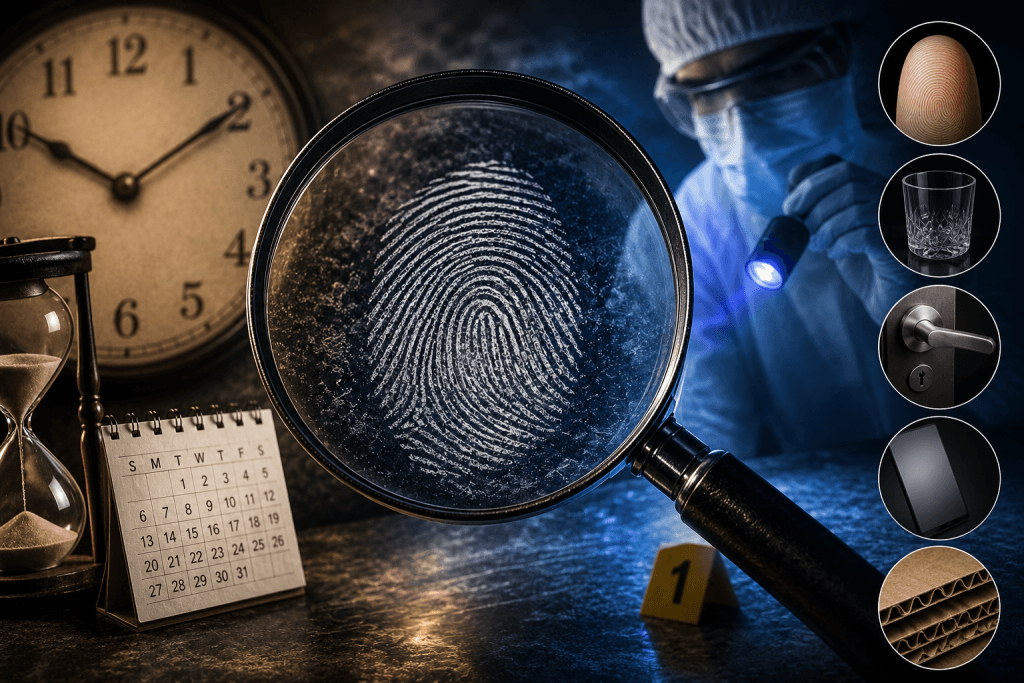
Forensic scientists have developed multiple techniques to recover fingerprints at various stages of degradation.
Powdering
Traditional dusting with aluminum or carbon-based powders works best on fresh prints, typically less than a few days old on smooth surfaces. It is the most common technique but also the most time-sensitive.
Chemical Development
Techniques like ninhydrin, DFO, and physical developer target the amino acid and fatty acid components of prints. These methods work on porous surfaces and can recover prints that are months or even decades old.
Vacuum Metal Deposition
This advanced technique deposits thin layers of gold and zinc onto a surface to reveal latent prints. It is effective even on surfaces where prints are highly degraded or very old.
Optical and Laser Techniques
Fluorescence examination under specific wavelengths of light can reveal prints that are invisible under normal lighting. This is particularly useful for prints that are weeks or months old.
Each of these methods answers a different version of how long do fingerprints last because each targets a different chemical component that degrades at a different rate.
Why Professional Fingerprinting Services Matter
Whether you are submitting prints for employment, immigration, licensing, or a background check, the quality of the original capture matters enormously.
A smeared, incomplete, or poorly inked fingerprint card can result in rejection by the receiving agency, which means delays and repeat appointments.
Professional fingerprinting technicians are trained to capture clean, complete ridge impressions that meet the specifications of federal, state, and local agencies.
At AI Fingerprinting, we specialize in delivering accurate, agency-compliant fingerprint submissions for clients across a wide range of needs. From Live Scan digital submissions to hard copy ink-and-roll cards, we make the process simple and reliable.
Knowing how long do fingerprints last in official systems also means understanding that accuracy at the point of collection sets the tone for every record that follows.
Fingerprinting for Immigration and Visa Applications
Immigration applications through USCIS and other federal agencies require biometric appointments where fingerprints are captured digitally. These prints are matched against databases maintained by FBI and DHS.
The captured biometrics are stored as part of your immigration file and can be retained for many years as part of your ongoing case history.
For applicants who need to resubmit or update their biometrics, understanding how long do fingerprints last in these systems helps clarify whether prior submissions are still valid or whether a new appointment is required.
Fingerprint Quality and Age: What Examiners Look For
When a fingerprint is submitted for examination or matching, analysts assess it based on the clarity of ridge detail, the completeness of the impression, and the presence of core features like loops, whorls, and arches.
As a fingerprint ages on a surface, ridge clarity deteriorates. Edges blur, gaps appear, and the overall pattern becomes harder to map against a known reference.
This degradation is why crime scene investigators work quickly to document and collect prints before environmental exposure reduces their evidentiary value.
It is also why how long do fingerprints last is not just a theoretical question but a practical one with real consequences for criminal justice and identity verification.
Common Myths About Fingerprint Lifespan
There are several widespread misconceptions worth addressing directly.
Myth: Fingerprints disappear after a few days.
This is false. On the right surfaces and under the right conditions, prints can survive for years or even decades. Forensic labs have developed prints from evidence stored for thirty years or more.
Myth: Washing your hands removes all traces of your fingerprints from objects you touched.
Washing your hands cleans your fingertips, but it does not erase prints already deposited on other surfaces.
Myth: Gloves completely prevent fingerprint transfer.
Thin latex or nitrile gloves can still transfer ridge patterns in some cases. Fabric gloves may leave weave impressions. Neither method is foolproof.
Myth: Database fingerprints are automatically deleted after a period of time.
Unless a legal expungement order is issued, most government databases retain fingerprint records indefinitely.
Understanding how long do fingerprints last requires separating fact from fiction, which is something that professional fingerprinting services and law enforcement agencies deal with every day.
Tips for Maintaining Clean Fingerprints Before Submission
If you are scheduled for a fingerprinting appointment, there are a few simple steps that improve the quality of your submission.
Avoid heavy manual labor or extended water exposure in the days before your appointment, as these can temporarily reduce ridge clarity.
Moisturize dry skin lightly in the days leading up to your session. Extremely dry or cracked skin can make it difficult to capture a complete ridge pattern.
Arrive with clean, dry hands. Residue from lotions, hand sanitizers, or food can affect ink adhesion or sensor read quality.
These small steps help ensure that the fingerprints captured at your appointment are accurate and accepted by the receiving agency on the first submission.
How AI Fingerprinting Can Help You
At AI Fingerprinting, we provide professional fingerprinting services designed to meet the standards of agencies across Oregon, Washington, and beyond.
Our team handles Live Scan electronic submissions, ink-and-roll card printing, ATF fingerprint card preparation, and EFT file creation for a wide range of clients including job seekers, license applicants, immigrants, and individuals completing legal or court-ordered requirements.
We understand how long do fingerprints last in every context, from a surface at a crime scene to a federal background check database, and we use that knowledge to help our clients get it right the first time.
Whether you are submitting for the first time or need to redo a prior submission, our technicians are ready to help.
Final Thoughts
So, how long do fingerprints last? The answer depends entirely on context.
On a smooth glass surface in a cool, dry room, a print can survive for months or longer. On a hot car hood in the rain, it may vanish in hours. On skin, the window is less than two hours. In a federal database, it could be forever.
What remains constant is the importance of understanding fingerprint science in every setting, whether you are a forensic investigator, a hiring manager, or someone simply trying to get a background check completed.
If you need professional, accurate, and agency-compliant fingerprinting services, visit us at aifingerprinting.com and let our team handle the details from start to finish.